
Vienna’s office market in 2026 presents a peculiar problem. There’s no shortage of space – the city has excellent commercial real estate across every district. There’s no shortage of options – from traditional office buildings to modern co-working spaces to hybrid concepts. And yet, companies looking for office space in Vienna, particularly scale-ups, corporate innovation teams, and growing tech companies, consistently report the same frustration: they can’t find what they need.
Not because the space doesn’t exist, but because most Vienna office solutions optimize for the wrong variables.
Traditional office space optimizes for stability: long leases, fixed layouts, predictable costs. Co-working spaces optimize for flexibility: short commitments, shared amenities, variable pricing. Both models serve specific needs. But for companies at a particular growth stage – past the scrappy startup phase but still in active scale mode – neither model fits cleanly.
Over 40 companies have found a different model at weXelerate, and understanding why reveals something important about what actually matters when choosing office space in Vienna.
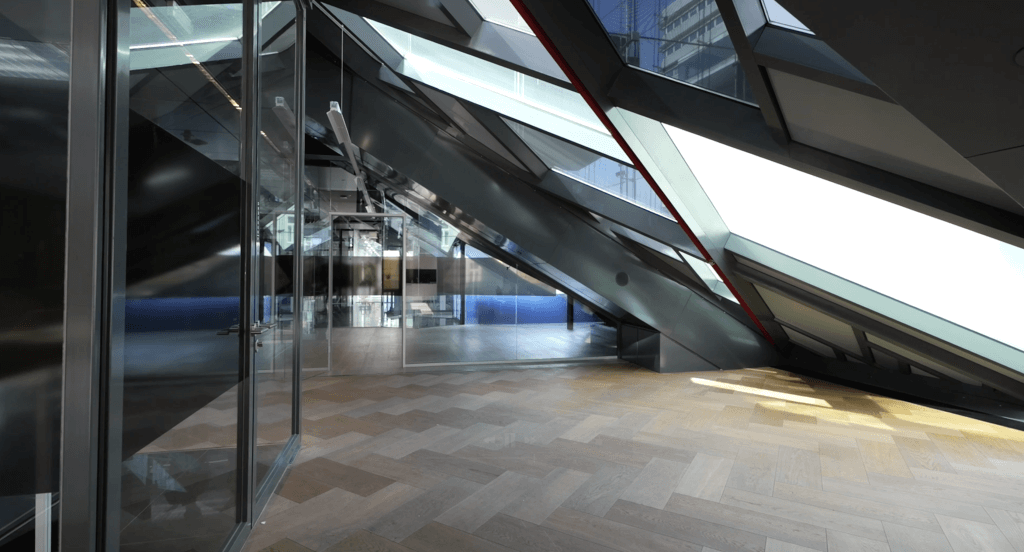
Why Traditional Office Space Fails Growing Companies
The traditional office space model in Vienna works beautifully for established companies with predictable headcount and stable operations. You find a building, negotiate a lease, build out your space, move in, and operate there for years.
For companies in active growth mode, every part of that sequence becomes a constraint:
Finding space means engaging brokers, paying agency fees, and navigating a market optimized for large corporate tenants or long-term residential conversions. The spaces designed for 10-30 person teams are limited, and the ones that exist often come with requirements that don’t match how modern companies operate.
Negotiating leases means committing to 5-10 year terms without knowing if your team will be 15 people or 50 people in two years. The traditional office lease assumes stability – but if you’re a scale-up, stability is exactly what you don’t have.
Building out space means months of design, permitting, construction, and installation before you can move in. Even if you find the right space, the time from signing to occupancy can easily stretch six months. For a company that needs to focus on product development and customer acquisition, that timeline is expensive in ways that don’t show up on the lease.
Operating there means managing facilities, coordinating cleaning services, handling technical issues, securing the space, and dealing with the hundred small logistics that building management entails. Again, for established companies with dedicated operations teams, this is routine. For growing companies where everyone is wearing multiple hats, it’s a constant tax on attention.
The most expensive part isn’t visible in the lease rate: it’s the opportunity cost of leadership time spent on office logistics instead of building the company.
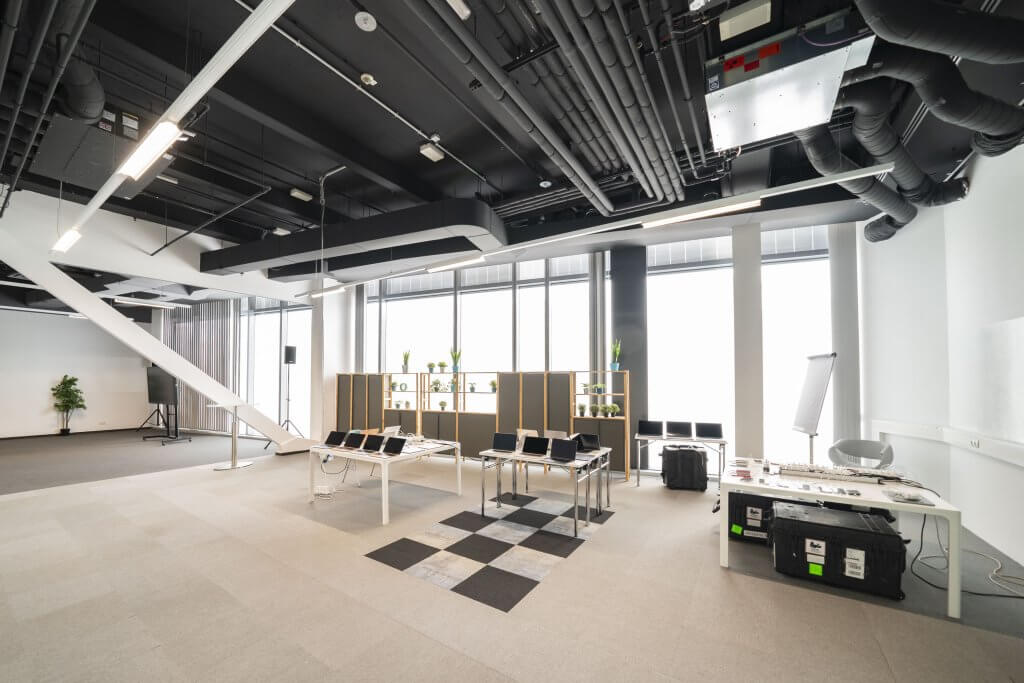
Why Co-Working Space Fails at Scale
The co-working boom offered an alternative: flexible membership, shared amenities, community atmosphere, no long-term commitment. For solo entrepreneurs, remote teams, and early-stage startups, this model works brilliantly.
But as companies scale past 10-15 people, co-working spaces create different problems:
Privacy becomes impossible. Open spaces work fine when you’re two founders at laptops. They break when you’re running sensitive client calls, conducting performance reviews, or discussing strategic planning. The flexibility that makes co-working attractive early becomes a limitation as organizational complexity grows.
Cost efficiency inverts. Co-working pricing is optimized for individuals and small teams. As you scale to 15, 20, 30 people, the per-person desk fees start exceeding what dedicated space would cost – but you still don’t have the privacy or customization that dedicated space provides.
Identity gets diluted. When your team is scattered across shared spaces with dozens of other companies, building cohesive culture becomes harder. The community aspect that co-working spaces emphasize works for networking but not for team coherence.
Scaling breaks the model. Co-working spaces can’t easily accommodate a team that grows from 15 to 30 people over six months. You end up scattered across different areas, or on waiting lists, or forced to move to a different location entirely.
The companies that succeed with co-working either stay small deliberately or use it as a temporary bridge while searching for permanent space. For companies in active scale mode, it’s rarely a long-term solution.
What Actually Matters for Office Space in Vienna’s Innovation Sector
Here’s what 40+ companies at weXelerate share in common: they’re all navigating a specific set of conditions that traditional office solutions don’t address well.
They’re growing unpredictably – headcount might increase 30% one quarter and stay flat the next. They need space that can flex without renegotiating leases or breaking multi-year commitments.
They’re operationally focused – their value is in building products, serving customers, or driving innovation. Office management is a necessary cost, not a core competency. They’d rather have someone else handle facilities.
They’re ecosystem-dependent – whether they’re corporate innovation teams, scale-ups, or tech companies, their success depends partly on being connected to the right networks, partners, and talent pools. Physical isolation in a traditional office building cuts off those connections.
They’re hiring actively – which means employer brand matters. The office communicates something to potential hires before the first interview. A generic office building signals stability. A vibrant innovation hub signals momentum.
They need legitimacy signals – particularly corporate innovation teams or scale-ups engaging with larger partners. The address, the building, the surrounding ecosystem all contribute to credibility.
Traditional Vienna office space and co-working spaces both miss several of these requirements. weXelerate’s fully managed office model addresses all of them simultaneously – which explains the retention rate.
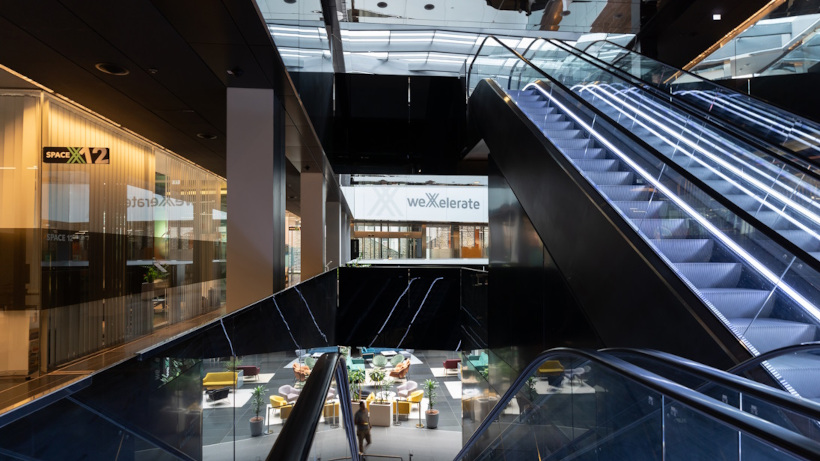
The Fully Managed Office Model
weXelerate calls it “fully managed office space,” but the label undersells what’s actually happening. The model is better understood as: private office space with all logistics handled, embedded in an active innovation ecosystem.
Here’s what that means practically:
Private space, dedicated to your company: Unlike co-working, you have your own office (100-380 m²) with your own door, your own configuration, your own identity. You can have confidential conversations, leave work on the walls, build team culture in your own space.
Fully managed operations: weXelerate handles the facility manager, technical manager, furniture and equipment, cleaning service, security, and high-speed internet. Your team shows up and works. When something breaks, someone else fixes it. This isn’t just about convenience – it’s about where leadership attention goes.
Ready to move in: The space is functional from day one. No build-out period. No furniture lead times. No technical installation delays. From lease signing to occupancy can be measured in weeks, not months.
Flexible scaling: As your team grows, you can expand into adjacent space or move to a larger office within the same building. No lease renegotiation with a new landlord. No moving to a different location. The ecosystem connections and address stability remain constant even as your space changes.
Ecosystem embedded: You’re in the same building as 40+ other growing companies, 80+ corporate innovation members, regular startup events, investor meetings, and the dense network of connections that characterizes active innovation ecosystems. The spontaneous collaborations and introductions happen because you’re physically embedded.
Community spaces included: 1,500 m² of shared lounges, meeting areas, and event zones complement your private office. When you need to host a client meeting, run a team workshop, or do a larger company event, the infrastructure is there. Members get 20% discount on event bookings and meeting rooms.
Hub services access: 24/7 office access, phone booths, showers, coffee bridge, table tennis area, on-site garage with EV charging, storage space, in-house restaurant (El Gaucho Steakhouse), and premium partner hotel (SO/ Vienna). These aren’t luxury amenities – they’re the practical infrastructure that makes the office work as a daily environment.
The cost structure reflects this positioning: it’s not priced like premium co-working (which would be prohibitively expensive for teams of 15-30), and it’s not priced like bare commercial space (which would require all the management overhead). The “on request” pricing for individual spaces reflects that each company has different needs, but the model is designed to be economically rational for companies in scale mode.
Why Location Matters More Than Rent
The weXelerate hub sits at Praterstrasse 1, 1020 Vienna – essentially 150 meters from the first district. For companies evaluating Vienna office space, location deserves more weight than most decision frameworks give it.
Prime city center access means your team isn’t commuting to business district periphery. The best talent in Vienna has options – reducing commute friction matters for retention. More importantly, being central means client meetings, partner discussions, and candidate interviews are logistically easy. The difference between a 20-minute commute and a 45-minute commute compounds across hundreds of meetings.
Excellent public transport links mean car ownership is optional. For companies hiring internationally or attracting talent from across Europe, this matters significantly. The environmental sustainability angle is real but secondary to the practical access.
Modern building infrastructure (the Design Tower, built recently) means the baseline technical infrastructure is contemporary. High-speed internet isn’t a feature – it’s assumed. EV charging in the garage isn’t a novelty – it’s expected. The space is barrier-free and dog-friendly, reflecting 2026 workplace expectations rather than retrofitted accommodations.
Innovation ecosystem density is the hidden location advantage. Being at Praterstrasse 1 doesn’t just mean being in Vienna’s second district – it means being at the physical center of Austria’s largest innovation hub. When DXC Technology, Agrana, ASFINAG, Austrian Standards, BKS Bank, Infineon, OMV, or any of the other 40+ companies and 80+ corporate members need to connect, they’re in your building.
That spatial density creates network effects that can’t be replicated by choosing cheaper office space in a less connected location. The cost differential between Praterstrasse 1 and a lower-rent district might be 20-30% – but the connectivity differential is easily 10x.
What the Numbers Actually Tell You
weXelerate currently houses 40+ companies across 9,000 m² of innovation space. Individual office sizes range from 100-380 m². Here’s what that breakdown reveals:
Space 21 (391 m²): This is for established teams or companies consolidating multiple functions. At nearly 400 m², you’re looking at capacity for 30-50 people depending on configuration.
Space 29 (328 m²): Similar scale, slightly smaller footprint. This works for companies that need dedicated space but with more compact layouts.
Space 32 (226 m²): This is the sweet spot for many scale-ups – large enough for a team of 20-30, small enough to maintain energy and cohesion.
Space 34 (114 m²): For smaller teams (10-15 people) or companies just moving from co-working into dedicated space.
The availability dates (most are January-February 2026) and the “on request” pricing model indicate two things: first, there’s turnover as companies graduate to even larger spaces or relocate for strategic reasons. Second, pricing is negotiable based on commitment length, team size, and specific configuration needs.
The “no agency fee” detail is financially significant. In Vienna’s commercial office market, broker fees typically run 2-3 months of rent. For a company paying €10,000/month for office space, eliminating the €20,000-30,000 agency fee is material savings.
The Real Differentiator: Events and Network Effects
Most Vienna office space analysis focuses on the physical space: square meters, layout, amenities. This misses the strategic variable: what happens around your office.
weXelerate hosts 130+ events per year (50+ exclusive members-only, 200+ public). These aren’t generic networking events – they’re structured around the innovation topics that companies at weXelerate are actively navigating: AI implementation, automation, corporate-startup collaboration, transformation management.
As an office tenant, you’re automatically invited to relevant events. Your team can attend workshops without leaving the building. When external companies host events at weXelerate, you have natural opportunities to connect.
The compound effect is that your office becomes more valuable over time as your network deepens. Traditional office space depreciates – the building ages, the location becomes less relevant, the infrastructure becomes outdated. Office space embedded in an active ecosystem appreciates – your relationships deepen, your reputation strengthens, your access improves.
This is particularly valuable for corporate innovation teams. If you’re running an innovation function for a large Austrian company, being embedded at weXelerate means you’re structurally connected to the startup ecosystem, VC community, and peer corporate innovators. You don’t need separate programs to access those networks – it’s ambient.
What Actually Matters for Office Space Decisions
For companies evaluating Vienna office options, the traditional decision framework is:
- Define space requirements (square meters, configuration)
- Set budget (rent per square meter)
- Choose location (district, commute time)
- Evaluate amenities (meeting rooms, parking, etc.)
- Negotiate lease (term, escalation, exit clauses)
This framework isn’t wrong, but it misses the strategic dimensions that determine whether the office actually helps or hinders company growth:
Does the office let leadership focus on the business, or does it create management overhead? The fully managed model at weXelerate eliminates facilities distraction. For companies where leadership time is the scarcest resource, this matters more than cost per square meter.
Does the office scale with the company, or force a future move? The ability to expand within the same building (both through adjacent space and through access to meeting rooms and event spaces) means you avoid disruptive relocations during critical growth periods.
Does the office connect the company to relevant ecosystems, or isolate it? Being embedded at weXelerate means continuous exposure to innovation partners, talent networks, and strategic opportunities. Traditional office space is neutral at best, isolating at worst.
Does the office strengthen employer brand, or is it invisible? When hiring competitive talent, the office communicates something about the company. A space at Austria’s largest innovation hub signals momentum differently than generic office space.
Does the office create optionality, or lock in commitments? The flexible scaling and manageable terms at weXelerate preserve strategic optionality. Traditional long-term leases in fixed spaces constrain future choices.
These questions matter more than square meter pricing, but they’re harder to quantify in a spreadsheet.
The Companies That Choose weXelerate
The 40+ current tenants at weXelerate reveal a pattern. They’re not all in the same industry or at the same stage. But they share a growth trajectory and strategic orientation:
Scale-ups that have proven product-market fit and are in active expansion mode. They’ve graduated from early-stage co-working but aren’t ready for enterprise office commitments.
Corporate innovation teams from larger Austrian companies (visible in the 80+ corporate members like OMV, Infineon, Erste Digital) who need physical presence in the innovation ecosystem, not just episodic access.
Tech companies operating in B2B software, deep tech, or innovation-adjacent sectors where ecosystem connections directly impact growth.
International companies establishing Austrian presence and needing both office infrastructure and local network access quickly.
What unites them is the recognition that office space is strategic infrastructure, not just real estate. The decision isn’t purely financial optimization – it’s about what position the office creates for the company’s next phase of growth.
The Strategic Bet
Choosing office space is a bet on what your company will need over the next 2-5 years. Traditional office leases bet on stability. Co-working bets on extreme flexibility. Fully managed office space at innovation hubs bets on embedded ecosystem access.
For Austrian companies navigating growth, digital transformation, or innovation-driven sectors, the ecosystem bet increasingly looks correct. Not because traditional office space is bad, but because the value of being structurally connected to where innovation happens compounds faster than cost savings from cheaper space in less connected locations.
The 40+ companies at weXelerate have made that bet. As Austria’s innovation ecosystem continues to densify around hubs like weXelerate, the question isn’t whether to be part of that ecosystem – it’s whether to do so peripherally through events and programs, or structurally through physical presence.
For companies where the answer is structural presence, the office decision becomes straightforward: find space where the ecosystem is, not where rent is cheapest.
Looking for office space in Vienna that scales with your growth? weXelerate offers 100-380 m² fully managed offices at Austria’s largest innovation hub. No agency fees. Ready to move in. Contact office@wexelerate.com or visit wexelerate.com/services/offices.